Trends in Basal Metabolic Rate After Age 35: Longitudinal Data
Longitudinal Research Frameworks
Large-scale longitudinal cohort studies provide the most reliable data on age-related changes in basal metabolic rate (BMR). The Baltimore Longitudinal Study of Aging, conducted in the United States, followed thousands of participants across multiple decades, measuring resting metabolic rate using indirect calorimetry. Similar prospective studies in the United Kingdom, Scandinavia, and Australia documented comparable patterns.
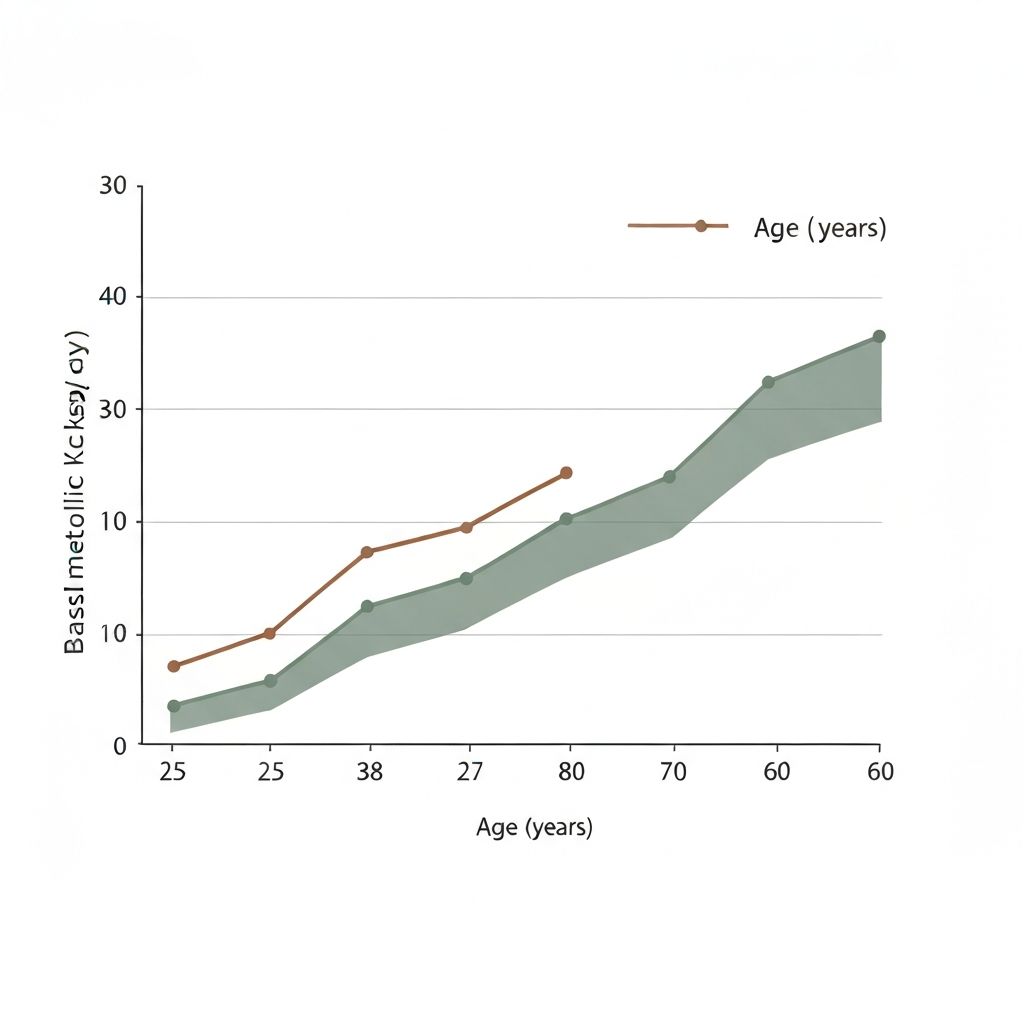
These investigations reveal that resting metabolic rate declines progressively across adult life, with acceleration notable around age 50. The average decline approximates 2 to 8 percent per decade after age 30, though individual variation is substantial.
Age-Specific BMR Patterns
Population averages show systematic reduction in absolute resting metabolic rate from early adulthood through older age. A 25-year-old woman with average body composition expends approximately 1,400 to 1,500 kcal daily at rest. By age 55, the average for similar body composition is 1,300 to 1,350 kcal daily. The absolute decline represents approximately 100 to 200 kcal daily over three decades.
For men, the pattern is comparable but with higher absolute values due to greater average muscle mass. A 25-year-old man averages 1,650 to 1,750 kcal daily at rest; by age 55, approximately 1,500 to 1,600 kcal.
Non-Linear Decline and Gender Differences
The decline in BMR is not uniform across the lifespan. Research indicates relatively stable metabolic rates from ages 25 to 40 in many individuals, with acceleration between ages 40 and 60. After age 70, the rate of decline stabilises in many cohorts.
Gender differences emerge in longitudinal analysis. Women show slightly steeper declines in BMR around perimenopause and postmenopause (ages 48 to 58), correlating with hormonal transitions. Men show more gradual, linear decline across midlife without discrete inflection points corresponding to hormonal changes.
Body Composition as the Primary Mediator
When longitudinal analyses control statistically for fat-free mass (FFM), the independent effect of age on BMR diminishes substantially. This finding indicates that body composition change, not chronological age per se, drives much of the observed metabolic decline. Individuals maintaining stable FFM across decades show minimal BMR reduction independent of body composition.
Individual Trajectories and Heterogeneity
Despite population-level trends, longitudinal data reveal substantial individual variation. Some participants maintain stable BMR across 20-year follow-up periods, while others experience declines exceeding 10 percent. Genetic factors, baseline fitness level, and consistency of physical activity patterns predict individual trajectories.
Measurement Standardisation and Reliability
Variations in measurement protocols—fasting duration, posture, ambient temperature—influence BMR values. Meta-analyses examining longitudinal studies that employed rigorous standardised protocols confirm the general pattern of age-related decline, though absolute magnitudes vary slightly among studies.